Friday, May 30, 2014
Finishing Up - Kayla
So far composting has been a great experience. I have learned a lot about the waste I produce and the best way to reduce that waste. Maintaing the compost is an easy task and it only takes a few minutes of work each day to make sure its in the best possible condition. I have made sure that we have the right mix of food waste and yard waste. I have also been making sure to aerate the compost pile to ensure continuing decomposition of the pile. I am glad that I had to opportunity to start this compost with my family because I know it is something that we will continue for as long as we can. I am glad that we could take a small step to reducing the thousands of pounds of waste that are put into landfills each year in the United States. I am also looking forward to continued composting and to finally using our compost around our house and hopefully one day making a garden and using the compost there. I hope you enjoyed our blog!

Looking Foward- Haley
As my project winds to a formal close, I know that my family and I will still be composting. This 2 weeks was just a start for something that will continue in my house. Although my project is almost done, the effect of having a compost definitely not disappear as the school year ends as well. With this project and by composting my family has greatly reduced the amount of waste that goes into the garbage. My family used to take out the garbage once every 2 days, give or take depending on dinners and who is home. By composting I have noticed that we only need to take the garbage out once every 3 days. My compost is right now just a pile in the back of my shed, but we have purchased wood to make a container to organize our compost more. Once completed, our composting process will be much more uniform and easier to follow, and I hope it will be as second nature to us as taking out the trash. In 3-4 months we will be able to use our compost in our growing garden that we have been working on as well. The most rewarding part of this project is knowing that some of my wastes are being broken down and used to hopefully in a few months help to grow our garden. Also, I find comfort in knowing that some of my waste wont be in a landfill that is leaking leachate and is taking up hundreds of thousands of miles of land in the US.
Thursday, May 29, 2014
Tending to your Compost
A well-constructed pile can produce compost in 3-6 months. If the decomposition is slow or you would like to accelerate the process, you can do so by turing and remoistening the pile and added more of the needed ingredients. Only a few days after you created the pile, it should shrink considerably. This happens because decomposers are using up the oxygen in the pile, collapsing the airspaces between the material. Even though this is occurring the decomposers need oxygen to do their job. To add more oxygen you need to add more organic matter to the pile. It is also important to aerate your compost. This is another easy way to add oxygen to your compost pile. The best way to aerate your pile is to turn the entire pile. As you aerate your pile you should moisten it. Your pile should be moist like a wrung-out sponge.
How To Build a Compost Pile
Are you ready to compost but don't have a bin? Do not worry at all! Building a pile is just as effective as building a pile in a bin.
First, chop, break, and shred most of the material into small pieces. Remember: The smaller the pieces of organic matter in your compost, the faster the rate of decomposition.
Then, build your pile alternating green and brown materials, like a layer cake. You could also just mix all of the browns and greens together, but that is usually harder for most people. When making a layer compost, follow these steps:
First, chop, break, and shred most of the material into small pieces. Remember: The smaller the pieces of organic matter in your compost, the faster the rate of decomposition.
Then, build your pile alternating green and brown materials, like a layer cake. You could also just mix all of the browns and greens together, but that is usually harder for most people. When making a layer compost, follow these steps:
- Start with 4 inches of chunky browns (sticks, woody trimmings, dried perennial stems, cornstalks, and the like) to promote aeration at the bottom.
- Add 4 to 5 inches of other browns (leaves, straw, woody trimmings, paper products, pine needles, sawdust).
- Add 2 to 3 inches (5 to 8 centimeters) of greens (kitchen scraps, grass clippings, leafy plant trimmings, manure).
- Repeat Steps 2 and 3 until you reach a pile height of 3 to 5 feet. Finish with a top layer of browns to insulate.
Whether you layer or mix your compost pile doesn't really matter. The more important issue is to ensure that all your recipe ingredients are sufficiently moist as you build. Use a hose with an on/off spray attachment, and sprinkle each layer of organic matter as you build. Everything should have the moisture level of a wrung-out sponge, so grab a handful every once in a while as you build to test it.
And thats it! Remember that the compost must be turned every few days and follow this guide you believe there is something wrong with your compost!
What's Wrong With my Compost?
| Problem | Cause | Solution |
|---|---|---|
| Slow decomposition | Lack of nitrogen | Add "green" nitrogen-rich organic matter. |
| Slow decomposition | Poor aeration | Turn pile. |
| Slow decomposition | Too dry | Turn pile and remoisten all materials. |
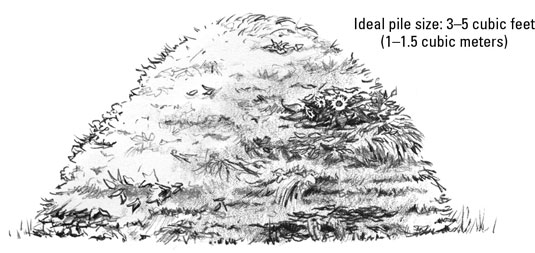
| Slow decomposition | Pile too small | Add more organic matter to increase pile size to 3–5 cubic feet (1–1.5 cubic meters). |
| Slow decomposition | Cold weather | Insulate outer pile with thick layers of cardboard, sod, straw, or leaves. Use a compost bin style with a lid to retain heat. Increase pile size. |
| Ammonia odor | Too much nitrogen | Add "brown" carbon-rich materials and remix. |
| Rotten odor | Too wet | Add "brown" carbon-rich materials and remix. |
| Attracts flies | Kitchen scraps too close to top of pile | Bury scraps in center of pile. Don't add meats, dairy, oils, or grease. |
| Attracts dogs, raccoons, or other pests | Kitchen scraps too close to top of pile | Bury scraps in center of pile. Don't add meats, dairy, oils, or grease. Use an animal-proof enclosed bin. |
| White or gray thread-like filaments resembling spider webs on the outer edges of the pile | Actinomycetes, a type of bacteria, are at work decomposing organic matter | No change required. These are "good guys" |
| Contains grubs, worms, and other large bugs | No worries! Indicates nature is at work. | No change required. |
Wednesday, May 28, 2014
Choosing a Location For Your Compost
Something everyone making a compost must take into consideration is the where. After you have finally decided to start a compost finding the right spot for it is essential. How much space you need depends on the ultimate scope of your composting operation and what style of bins, if any, you decide to use. If you are making a freestanding pile of organic matter without a bin enclosing it should be at least 3 feet long x 3 feet wide x 3 feet tall and up to 5 x 5 x 5 feet.
If you are using a bin then find an area that is big enough to fit it and don't forget to allow yourself elbow room to comfortably swing a pitchfork loaded with organic matter and shovel your finished compost into a bucket, wheelbarrow, or cart for transport elsewhere in the landscape. To be a good neighbor, take into account your neighbors' views or potential concerns. Will your bins piled high with straw and fresh manure be visible from your neighbors' patio? Also, check homeowner association or other municipal regulations that may limit your options. Don't let lack of space deter you from composting. Even the smallest courtyard garden or balcony has a corner for a compact compost bin design or a worm bin, and good-looking bin designs are available for those who have nowhere to hide their composting efforts. Check out this post for how to compost in a city. Regardless of where you live, site your compost area in the shade if at all possible. Shade keeps the organic matter from drying out rapidly and also keeps you from dehydrating in the sun when the time comes to toss a ton of organic matter.
If you are using a bin then find an area that is big enough to fit it and don't forget to allow yourself elbow room to comfortably swing a pitchfork loaded with organic matter and shovel your finished compost into a bucket, wheelbarrow, or cart for transport elsewhere in the landscape. To be a good neighbor, take into account your neighbors' views or potential concerns. Will your bins piled high with straw and fresh manure be visible from your neighbors' patio? Also, check homeowner association or other municipal regulations that may limit your options. Don't let lack of space deter you from composting. Even the smallest courtyard garden or balcony has a corner for a compact compost bin design or a worm bin, and good-looking bin designs are available for those who have nowhere to hide their composting efforts. Check out this post for how to compost in a city. Regardless of where you live, site your compost area in the shade if at all possible. Shade keeps the organic matter from drying out rapidly and also keeps you from dehydrating in the sun when the time comes to toss a ton of organic matter.
How to Speed up your Compost
4 simple steps to speed up the composting process-
1. Chop or shred all your materials into small pieces before adding them to your compost
2. Turn the pile, make sure the material on the outside gets mixed into the material on the inside, this will promote decomposition
3. After a week or two turn the entire pile and remoisten it
4. Repeat these steps very week or two, watch the heat and moisture of your compost and you will quickly have harvestable compost!
1. Chop or shred all your materials into small pieces before adding them to your compost
2. Turn the pile, make sure the material on the outside gets mixed into the material on the inside, this will promote decomposition
3. After a week or two turn the entire pile and remoisten it
4. Repeat these steps very week or two, watch the heat and moisture of your compost and you will quickly have harvestable compost!
Subscribe to:
Posts (Atom)